
Mine water heat recovery
A secure low carbon heating solution across Great Britain’s coalfields
We estimate that 25% of properties are located on the coal mining reporting area, including major conurbations in England, Scotland and Wales. As such, mine water heat recovery is our most exciting opportunity to help develop zero carbon heat opportunities and create a more secure future for heating in Great Britain.
Domestic coal mining has reduced and humanity now recognises the impacts of burning carbon on our climate. We are now seeking alternative ways to maximise low-carbon opportunities from closed and abandoned mines, such as mine water heat networks.
This article explains what mine water heat is and how it can be used to support secure low carbon heat networks, representing a significant opportunity for Great Britain.
What is mine water heat?
Following the closure of underground coal mines, dewatering pumps are turned off, and the disused workings can gradually fill with water. The water that fills the abandoned workings is warmed by natural geothermal energy, often maintaining a stable temperature ranging from 10°C to 20°C, depending on depth. The geothermal heat held in this underground mine water is what we refer to as mine water heat.
This short BBC News story explains how heat from disused coal mines can be used to heat homes and business across Great Britain.
How can you access mine water heat?
There are three main ways to access mine water heat, and each suits different site conditions and project goals.
Mine water heat can be accessed by drilling boreholes into underground workings, using mine water from existing treatment schemes or by accessing suitable shafts. Once mine water has been accessed then the heat held within it can be recovered and distributed to buildings, usually through the use of heat exchangers and heat pumps, to boost temperatures. On average only 5°C is needed to be recovered from the mine water. The following sections describe the main ways that mine water heat can be accessed.
1. Borehole-based heat schemes
Boreholes are drilled to intercept water held within abandoned and disused coal mine workings. For a successful mine water heat scheme boreholes are required to both abstract mine water and then to safely return it back underground. Most mine water heat systems using boreholes will have at least two boreholes for this purpose and some will have more to build resilience and monitoring into the system.
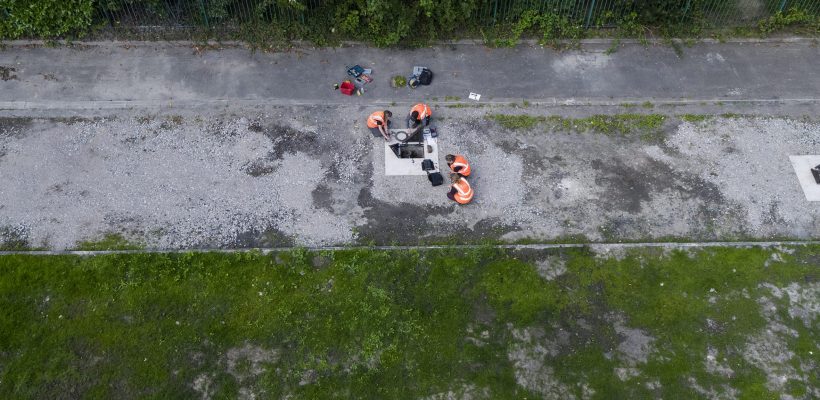
Boreholes can be tested to confirm how much water can be sustainably abstracted and returned into the mining system and this process is overseen by both the environmental regulators and the Mining Remediation Authority. Watch as we send a camera 146m down a borehole and explain the findings.
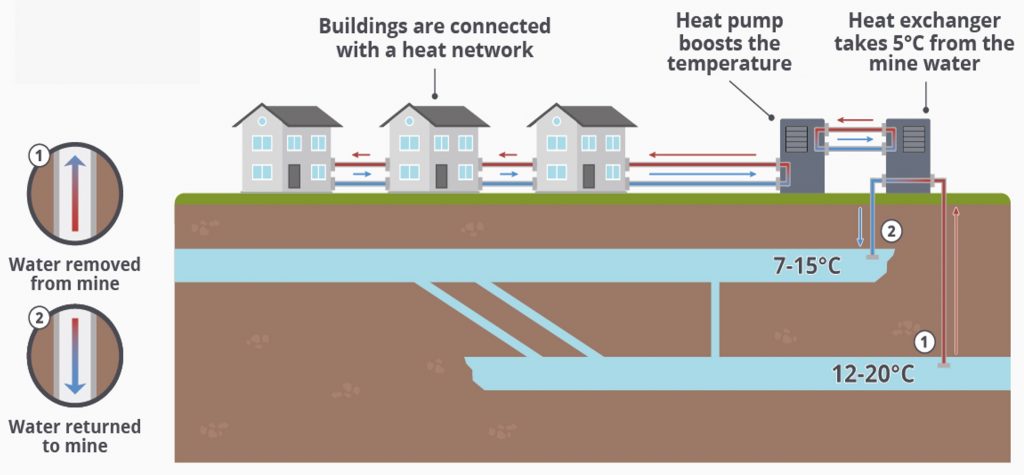
Once mine water is pumped to the surface a heat exchanger takes on average about 5°C from the mine water and a heat pump elevates the temperature before the heat is transferred to a clean water network to buildings. Once the heat has been removed from the mine water it is safely returned below ground to be warmed again.
Case study:
In Gateshead, the Mining Remediation Authority has supported the council-owned Gateshead Energy Company and contractors to deliver a mine water heating scheme that will feed into an existing district heating network.
Heat from mine water contained in workings 150m beneath Gateshead town centre is used to supply the heat network. A 6-megawatt (MW) water source heat pump recovers heat and distributes it via a network of heat network pipes over 5 km long. Currently this network supplies heat to a range of building types including; Gateshead College, the Baltic Arts Centre, several offices and over 600 council owned homes.
This project has an estimated saving of 72,000 tonnes of CO2 over 40 years which equates to annual savings of about 1,800 tonnes CO2 per annum.
2. Waste Heat schemes
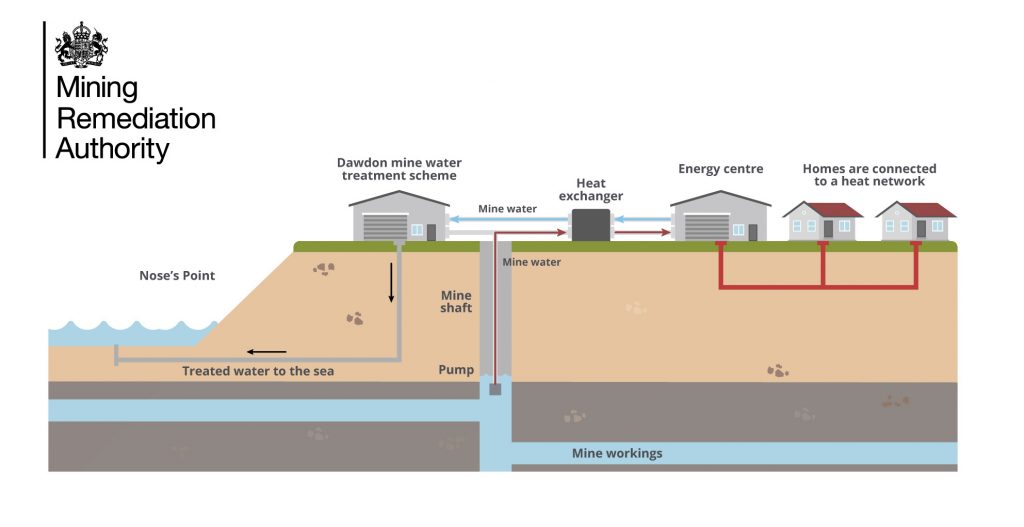
Waste heat refers to heat that is recovered from mine water that has already been pumped to the surface as part of an existing operation—most commonly at mine water treatment schemes. Where the Mining Remediation Authority already pump water to the surface to prevent pollution of rivers and groundwater, these sites offer clear opportunities for heat recovery.
In these waste heat schemes, warm mine water is abstracted for environmental protection and treatment purposes, and heat is then recovered from the water before or after the treatment process.
The heat is therefore a secondary benefit of an activity that is already taking place, rather than the primary purpose of the treatment scheme.
A heat exchanger typically takes about 5°C from the mine water and because pumping already happens, electricity costs to run the heat scheme are much reduced. Heat exchangers and heat pumps can often provide several times more heat output than the electricity they require to operate.
Increasingly, mine water treatment sites across Great Britain, including at Dawdon, in North East England and Lindsay in South Wales, already support this approach.
Mine shafts
Mine shafts once provided access to collieries across Great Britain, and the vast majority of mine shafts have now been filled or capped as part of ongoing safety measures. However, some historic mine shafts which can still be used to access mine water are used for pumping and control of mine water levels. Where shafts are safe and in good condition, they can provide access to mine water without the need to drill new boreholes, and this presents an opportunity for heat recovery. Every shaft requires careful assessment, and safety always comes first.
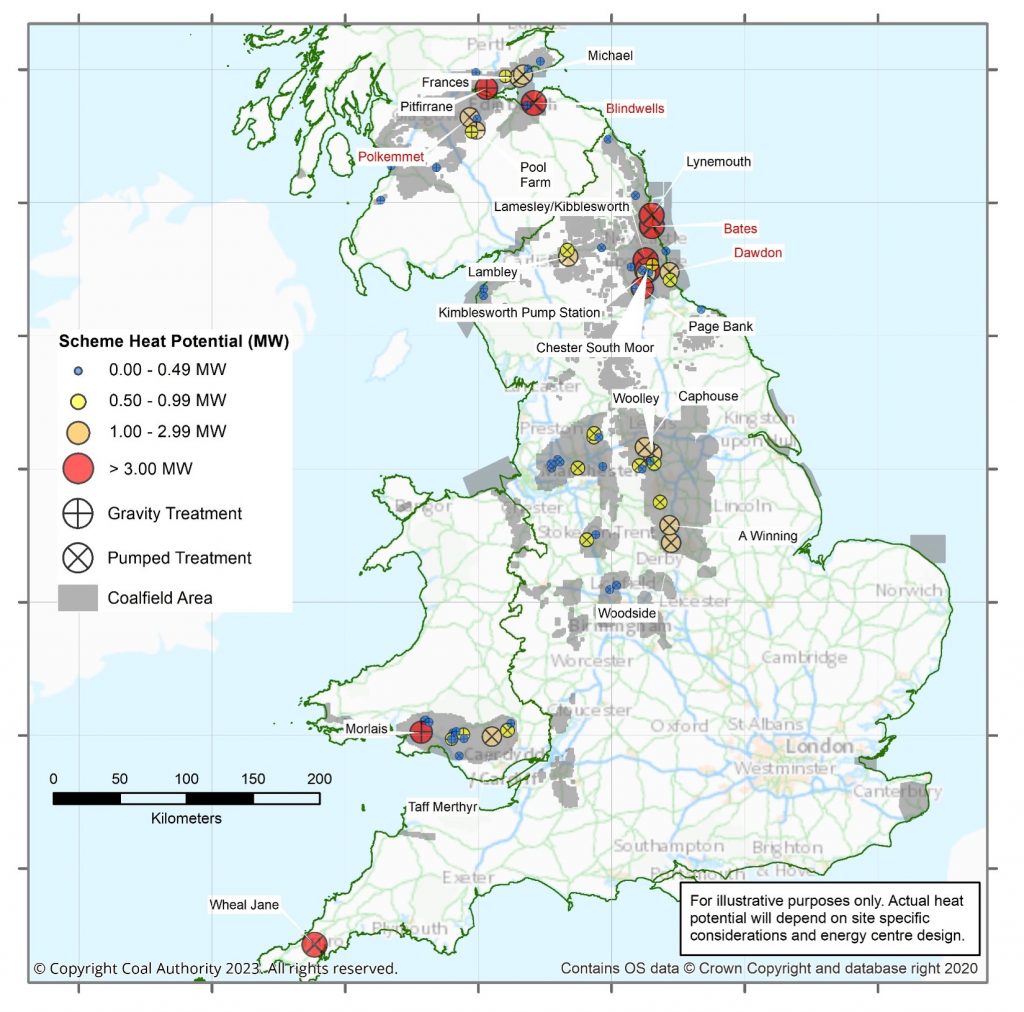
Mine water heat at surface in our treatment schemes represents a significant low-carbon heating source. The heat potential is linked closely to the available mine water flow and the largest schemes can provide over 6MW of heat for space heating and hot water to new-build or retrofit development. These outputs are suitable for heat networks serving housing, public buildings and commercial users. Importantly, the opportunity aligns closely with population centres.
We worked with Ordnance Survey to map recorded coal mine workings and population centres. Watch this short video to see the correlation:
Waste Heat in Scotland
Scotland illustrates this opportunity clearly. Around half of properties sit above the workings of underground coal mines, and several mine water heat recovery schemes already operate or are in development.
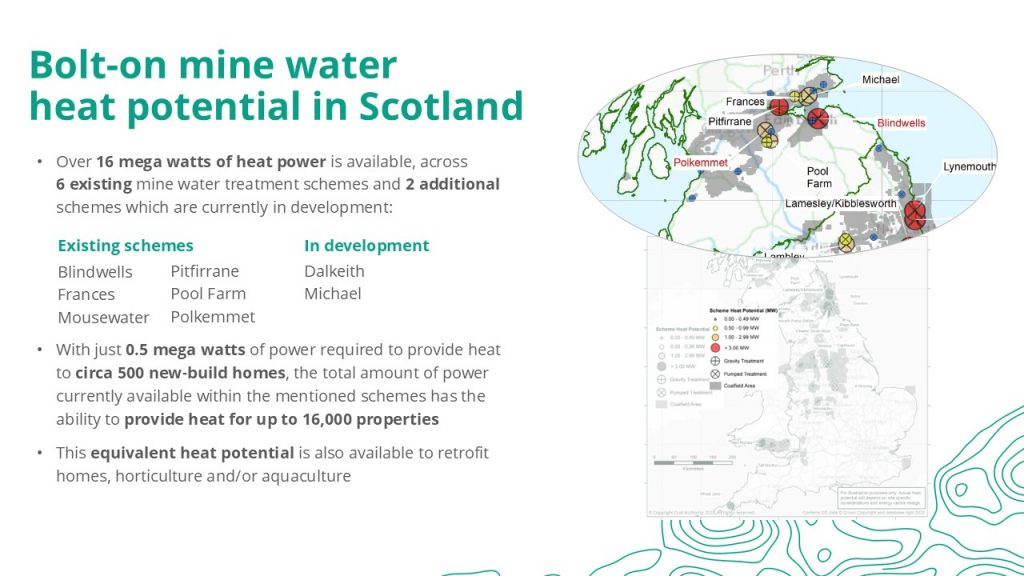
Together, these projects demonstrate how geothermal heat from mines can support communities at scale. The same principles apply across Great Britain.
Delivering for coalfield communities
Mine water heat provides an exciting opportunity across Great Britains coalfield areas, with the potential to provide stable priced, low carbon, home grown heat for homes, businesses, industry and agriculture.
Alongside this, mine water heat recovery can also support regeneration within former mining communities, reusing existing underground assets, or heat already available at surface through treatment schemes, to provide good green jobs and to enable future development.
Future opportunities
We are committed to supporting ‘home grown’ mine water heat schemes across Great Britain and the recovery of mine water heat is now a proven technology illustrated by several operational mine water heating schemes.
Future opportunities could involve using mine water for cooling of buildings or even for data centre cooling, whilst the mine working infrastructure below ground could also have potential to be used for thermal storage.
We undertake our own research and support academics and researchers across the country who are actively addressing the future opportunities that mine water could deliver to secure our low carbon heating systems.
How we can support mine water heat projects
We work with both private and public sector partners, to enable opportunities for mine water heat, combining our skills and expertise to deliver our priorities.
Our dedicated staff, comprised of leading geologists, hydrogeologists, and other specialists, is advancing mine water heat as a key contributor to low-carbon, sustainable heat.
With unique knowledge, assets, and data, we support innovative research and development, ensuring that our projects are informed by advanced science and robust evidence. This expertise gives our public and private partner’s confidence in the opportunity that mine water heat represents.
If you have any questions about the potential of mine water heat recovery in your area, explore our articles or get in touch by emailing us to see how we could support you.